 Angles: Complementary, Supplementary, Vertical, and Linear Pairs
You may want to review:
For this web exercise, assume all angles are measured in degrees.
Two angles are complementary if and only if the sum of their measures is $\,90^{\circ}\,.$
Two angles are supplementary if and only if the sum of their measures is $\,180^{\circ}\,.$
In particular:
- if $\,\angle 1\,$ and $\,\angle 2\,$ are complementary, then $\,m\angle 1 + m\angle 2 = 90^{\circ}\,$
- if $\,\angle 1\,$ and $\,\angle 2\,$ are supplementary, then $\,m\angle 1 + m\angle 2 = 180^{\circ}\,$
Rays that:
- share a common endpoint, and
- point in opposite directions
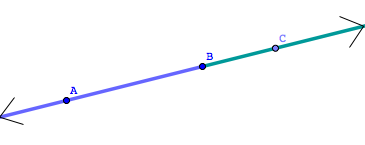
Note: If three points are on a line with $\,B\,$ between $\,A\,$ and $\,C\,,$ then $\,\overrightarrow{BA}\,$ and $\,\overrightarrow{BC}\,$ are opposite rays.
Recall that both $\,A{-}B{-}C\,$ and $\,C{-}B{-}A\,$ are notation for ‘$B\,$ is between $\,A\,$ and $\,C\,$’.
Two angles are a linear pair if and only if
- they have a common side, and
- their other sides are opposite rays.
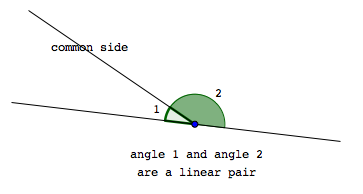
Note: If $\,\angle 1\,$ and $\,\angle 2\,$ are a linear pair, then $\,m\angle 1 + m\angle 2 = 180^{\circ}\,.$
Two angles are vertical angles if and only if the sides of one angle are opposite rays to the sides of the other.
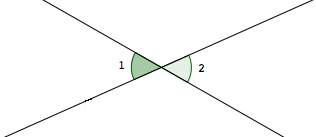
Note: Vertical angles are the ‘opposite angles’ that are formed by two intersecting lines.
Note: If $\,\angle 1\,$ and $\,\angle 2\,$ are vertical angles, then $\,m\angle 1 = m\angle 2\ .$
Two lines are parallel if and only if they lie in the same plane and do not intersect.
Parallel lines are studied in more detail in a future section, Parallel Lines.
The symbol ‘$\,\parallel\,$’ is used to denote parallel lines.
The sentence ‘$\,\ell\parallel m\,$’ is read as ‘$\,\ell \,$ is parallel to $\,m\,$’, and is true precisely when line $\,\ell\,$ is parallel to line $\,m\,.$
The symbol ‘$\,\perp\,$’ is used to denote perpendicular lines.
The sentence ‘$\,\ell\perp m\,$’ is read as ‘$\,\ell \,$ is perpendicular to $\,m\,$’, and is true precisely when line $\,\ell\,$ is perpendicular to line $\,m\,.$
Example
| $7x-15= 2x+55$ | vertical angles have equal measures |
| $5x-15=55$ | subtract $\,2x\,$ from both sides |
| $5x=70$ | add $\,15\,$ to both sides |
| $x=14$ | divide both sides by $\,5$ |