 More Terminology for Segments and Angles
You may want to review: Segments, Rays, Angles
Harold R. Jacobs has written a great Geometry book, entitled Geometry: Seeing, Doing, Understanding, third edition. It has many excellent exercises. The notation used here for betweenness of points is the same notation that is used by Jacobs.
Any line can be ‘transformed’ into a number line by choosing locations for zero ($\,0\,$) and one ($\,1\,$). With these choices, the positions of all other real numbers are uniquely determined.
A number line is a conceptually perfect picture of the real numbers: each point on the line corresponds to a unique real number, and each real number corresponds to a unique point on the line.
When points are located on a number line, it is convenient to use the following convention:
The coordinate of point
$\,A\,$
is denoted by
$\,a\,.$
The coordinate of point $\,B\,$
is denoted by $\,b\,.$
Thus, uppercase letters are used to denote points, and the corresponding lowercase letter is used to denote the coordinate of the point.
In Geometry, you want to be careful to distinguish between a point (an exact location), and a number (that might be used to specify the location of the point, relative to a chosen coordinate system).
Recall that, given any two real numbers $\,x\,$ and $\,y\,,$ we can talk about the distance between them:
- If $\,x\gt y\,,$ then the distance between them is $\,x-y\,.$
- If $\,x\lt y\,,$ then the distance between them is $\,y-x\,.$
- A general formula for the distance between $\,x\,$ and $\,y\,$ is $\,|y-x|\,$ (or $\,|x-y|\,$). That is, to find the distance between any two real numbers, subtract them (in any order) and then take the absolute value.
The distance between points $\,A\,$ and $\,B\,$ is the length of the segment $\,\overline{AB}\,,$ and will be denoted by $\,AB\,$ (no overline). Thus, $\,\overline{AB}\,$ is a geometric figure (a line segment), but $\,AB\,$ is a number that specifies the length of the line segment $\,\overline{AB}\,.$
Given three points on a line, it is often convenient to talk about one of the points being between the other two:
Let $\,A\,,$ $\,B\,,$ and $\,C\,$ be three points on a line, with corresponding coordinates $\,a\,,$ $\,b\,$ and $\,c\,.$
We say: $$ \begin{gather} \cssId{s47}{B \text{ is between } A \text{ and } C}\cr \cssId{s48}{\text{if and only if}}\cr \cssId{s49}{a\lt b\lt c \ \ \text{ or }\ \ a\gt b\gt c} \end{gather} $$
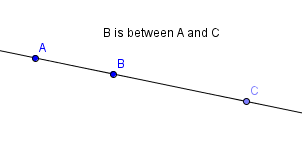
The sentence ‘$B\,$ is between $\,A\,$ and $\,C\,$’ will be notated by either $\,A{-}B{-}C\,$ or $\,C{-}B{-}A\,.$ Notice that whenever $\,B\,$ is between $\,A\,$ and $\,C\,,$ then $\,BA + BC = AC\,.$
Recall that $\,\angle AVB\,$ denotes the angle with vertex $\,V\,,$ with point $\,A\,$ on one side, and point $\,B\,$ on the other side.
As discussed earlier, angles can be measured with a protractor. Often, angles are measured in degrees.
The notation ‘$\,m\angle AVB\,$’ is used to denote the measure of $\,\angle AVB\,.$ Thus, $\,\angle AVB\,$ is a geometric figure (an angle), but $\,m\angle AVB\,$ is a number that measures how ‘wide’ the angle is.
Angles are classified according to their size:
An angle is acute if and only if its measure is strictly between $\,0^{\circ}\,$ and $\,90^{\circ}\,.$
An angle is a right angle if and only if its measure is $\,90^{\circ}\,.$
An angle is obtuse if and only if its measure is strictly between $\,90^{\circ}\,$ and $\,180^{\circ}\,.$
An angle is a straight angle if and only if its measure is $\,180^{\circ}\,.$
Two geometric figures are said to be congruent if they coincide exactly when superimposed, one on the other. Congruent figures have exactly the same size, and exactly the same shape.
For segments and angles, we can decide if they are congruent by looking at their measures: Line segments are congruent if and only if they have the same lengths. Angles are congruent if and only if they have the same measures.