 Practice with Slope
Want some basic practice first? Introduction to the Slope of a Line
In a rush? Need to skip the concepts and jump right to the slope formula? (Please come back and explore the beautiful ideas at a later time.)
Consider the equation $\,y = mx + b\,.$ As we'll see in this section, every equation of this form graphs as a non-vertical line in the coordinate plane.
In this equation, $\,m\,$ is the coefficient of the $\,x$-term, and $\,b\,$ is a constant term. For example, in the equation $\,y = 2x + 3\,,$ we have $\,m = 2\,$ and $\,b = 3\,.$
The number $\,m\,$ is called the slope of the line, and gives information about the ‘slant’ of the line. It answers questions like: “Is it an uphill or downhill line? How steep is it?” The purpose of this section is to explain why this is true.
Why does $\,y = mx + b\,$ graph as a line? Why does the number $\,m\,$ give info about the slant of this line?
The key idea (which we'll prove below) is that the equation $\,y = mx + b\,$ defines a very special relationship between $\,x\,$ and $\,y\,$: equal changes in $\,x\,$ (the input) give rise to equal changes in $\,y\,$ (the output).
Indeed, if $\,x\,$ changes by an amount $\,\Delta x\,$ (read aloud as ‘delta ex’ or ‘change in ex’), then $\,y\,$ changes by $\,m\Delta x\,.$ That is, $\,y\,$ changes $\,m\,$ times as fast as $\,x\,.$ This is a bit symbol-intensive, so let's look at a concrete example.
Suppose that $\,m\,$ is $\,2\,.$ (See the sketch below.) Then, $\,y\,$ changes $\,2\,$ times as fast as $\,x\,$ (that is, twice as fast as $\,x\,$). If (say) $\,x\,$ changes by $\,1\,,$ then $\,y\,$ will change by $\,2(1) = 2\,.$ If (say) $\,x\,$ changes by $\,5\,,$ then $\,y\,$ will change by $\,2(5) = 10\,,$ and so on.
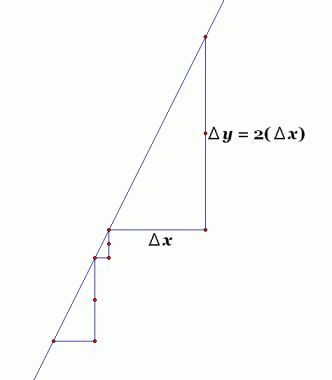
Here's another way to look at it. Imagine you're ‘standing on’ a point in the coordinate plane. Let's force $\,y\,$ to change twice as fast as $\,x\,,$ and see what new points result:
If you take $\,1\,$ step to the right (i.e., let $\,x\,$ change by $\,1\,$), then you'll have to take $\,2\,$ steps up (i.e., let $\,y\,$ change by $\,2\,$). Do it again—one step to the right, two steps up. Do it again—one step to the right, two steps up. (Repeat, if you want, with different changes in $\,x\,.$ ) Hmmm$\,\ldots\,$ what pattern are these points creating? A line!!
If we repeat the previous exercise with $\,m=100\,,$ think about the line that would result: one step to the right, $\,100\,$ steps up. Pretty steep line! So, clearly, the number $\,m\,$ gives information about the steepness or ‘slant’ of the line.
The next part is a bit technical, so perhaps a break is in order first!
Proof That, in the Equation $\,y=mx+b\,,$ Equal Changes in $\,x\,$ Give Rise to Equal Changes in $\,y\,$
Let $\,(x_1,y_1)\,$ be a point on the graph of $\,y = mx + b\,,$ so that $\,y_1 = mx_1 + b\,.$ That is, when you substitute $\,x_1\,$ for $\,x\,$ and $\,y_1\,$ for $\,y\,,$ the resulting equation is true.
Let $\,x_1\,$ change by an amount $\,\Delta x\,,$ to get a new $\,x\,$-value: $\,x_2 = x_1 + \Delta x\,.$ Let $\,y_2\,$ represent the $\,y$-value corresponding to $\,x_2\,.$ Then,
| $y_2 = mx_2 + b$ | find the $\,y$-value corresponding to $\,x_2\,$; call it $\,y_2\,$ |
| $\quad\, = m(x_1 + \Delta x) + b$ | substitute $\,x_1 + \Delta x\,$ for $\,x_2\,$ |
| $\quad\, = mx_1 + m\Delta x + b$ | multiply out; i.e., use the Distributive Law |
| $\quad\, = (mx_1 + b) + m\Delta x$ | re-order and re-group |
| $\quad\, = y_1 + m\Delta x$ | look back: $\,mx_1 + b\,$ is precisely $\,y_1\,$ |
Thus, $\,y\,$ has changed by $\,m\Delta x\,.$
Make sure you see this!
| The starting point is: | $($ | $x_1$ | $,$ | $y_1$ | $)$ |
| The ending point is: | $($ | $x_1 + \Delta x$ | $,$ | $y_1 + m\Delta x$ | $)$ |
So, when $\,x\,$ changes by $\,\Delta x\,,$ $\,y\,$ changes by $\,m\Delta x\,.$
A Formula for Slope
Let's summarize things from the previous proof.
- We started at $\,(x_1,y_1)\,.$
- We ended at $\,(x_2,y_2)\,.$
-
The change in $\,x\,$ is: $\,\Delta x = x_2 - x_1\,$
A ‘change in $\,x\,$’ is informally called a run, since it is in the left/right direction.
Memory device: Run to the right! Run to the left!
-
The change in $\,y\,$ is: $\,\Delta y = y_2 - y_1\,$
A ‘change in $\,y\,$’ is informally called a rise, since it is in the up/down direction.
Memory device: Rise up!
- And, we learned that the change in $\,y\,$ is $\,m\Delta x\,$: in equation form, $\,\Delta y = m\Delta x\,.$
Solving this last equation for the slope, $\,m\,,$ gives us an important formula:
Analysis of the Slope Formula
There are lots of important things you should know about the slope formula:
- How to Use the Slope Formula: To find the slope of a non-vertical line, you can choose any two different points on the line. Take the difference of the $\,y$-values. This is your ‘rise’. Take the difference of the $\,x$-values. This is your ‘run’. Divide rise by run, and you've got your slope!
-
Be Careful—Order is Important!
Once you do your first subtraction,
the next subtraction must be done
in the same order.
For example, suppose your two points are $\,(1,5)\,$ and $\,(3,12)\,.$ If you say $\,\Delta x = 3-1=2\,,$ then you must say $\,\Delta y = 12-5 = 7\,,$ and $\,m = \frac{7}{2}\,.$
Or: If you say $\,\Delta x = 1-3=-2\,,$ then you must say $\,\Delta y = 5-12 = -7\,,$ and $\,m = \frac{-7}{-2} = \frac 72\,.$
Either way is fine. But don't use (say) $\,3-1\,$ for one and $\,5-12\,$ for the other!
- Run: If the change in $\,x\,$ is $\,2\,,$ you go to the right two. If the change in $\,x\,$ is $\,-2\,,$ you go to the left two. ‘Run’ is positive to the right, and negative to the left.
- Rise: If the change in $\,y\,$ is $\,2\,,$ you go up two. If the change in $\,y\,$ is $\,-2\,,$ you go down two. ‘Rise’ is positive up, and negative down.
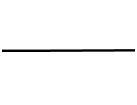
- Horizontal Lines: Since two points on a horizontal line have the same $\,y$-value: $$ \cssId{s158}{\text{slope}} \cssId{s159}{= \frac{y_2-y_1}{x_2-x_1}} \cssId{s160}{= \frac{0}{x_2-x_1}} \cssId{s161}{= 0} $$ The slope of a horizontal line is zero.
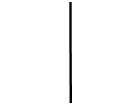
- Vertical Lines: Since two points on a vertical line have the same $\,x$-value, an attempt to compute the slope fails: $$ \begin{align} \cssId{s166}{\text{slope}}\ &\cssId{s167}{= \frac{y_2-y_1}{x_2-x_1}} \cssId{s168}{= \frac{y_2-y_1}{0}}\cr\cr &\cssId{s169}{= \text{Can't continue!}} \end{align} $$ Division by zero is not allowed. Thus, you can't compute the slope of a vertical line. We say that vertical lines have no slope.
- Zero Slope versus No Slope: Note that ‘zero slope’ and ‘no slope’ mean two entirely different things! Horizontal lines have zero slope; vertical lines have no slope.
|
|
|
horizontal line, zero slope |
vertical line, no slope |
-
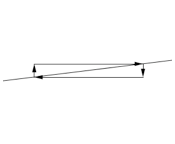
Uphill Lines,
Positive Slope:
Imagine you're standing on a
line in the coordinate plane,
walking from left to right.
If you're going uphill,
then we'll informally call this
an ‘uphill line’.
On uphill lines,
if you rise-and-run from
point-to-point,
one of two situations occur:
- Rise and run are both positive, so: $$ \cssId{s190}{\text{slope}} \cssId{s191}{= \ \frac{+}{+}}\ \cssId{s192}{= \text{positive}} $$
- Rise and run are both negative, so: $$\cssId{s194}{\text{slope}} \cssId{s195}{= \ \frac{-}{-}}\ \cssId{s196}{= \text{positive}} $$
| Uphill Lines, Positive Slopes | |
|
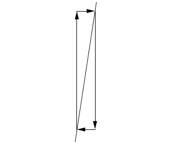
|
|
Gradual uphill, small positive slope |
Steep uphill, large positive slope |
| Downhill Lines, Negative Slopes | |
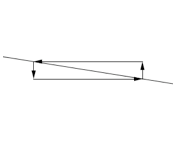 |
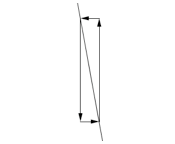 |
|
Gradual downhill, small negative slope |
Steep downhill, large negative slope |
-
Downhill Lines, Negative Slope:
Imagine you're standing on a line
in the coordinate plane,
walking from left to right.
If you're going downhill,
then we'll informally call this
a ‘downhill line’.
On downhill lines,
if you rise-and-run from
point-to-point,
one of two situations occur:
- Rise is positive and run is negative, so: $$ \cssId{s217}{\text{slope}} \cssId{s218}{= \ \frac{+}{-}} \ \cssId{s219}{= \text{negative}} $$
- Rise is negative and run is positive, so: $$ \cssId{s221}{\text{slope}} \cssId{s222}{= \ \frac{-}{+}}\ \cssId{s223}{= \text{negative}} $$
Examples
$$ \cssId{s229}{\text{slope}} \cssId{s230}{= \frac{-5-3}{2-(-1)}} \cssId{s231}{= \frac{-8}{3}} \cssId{s232}{= -\frac83} $$ The answers in this exercise are reported as fractions, in simplest form.
no slope zero slope
no slope zero slope
positive negative
Concept Practice
Answers are reported as fractions in simplest form.