 Addition of Signed Numbers
Problems like $(-2) + (-3) = -5$ and $\,(-3) + 5 = 2\,$ are easy for some people and hard for others. If they're easy for you, then try a few problems below, and then jump right to the exercises.
Otherwise, read on—and keep in mind that explaining something simple, in words, often ends up sounding very complicated!
| Click the ‘New Problem’ button to practice adding signed numbers. Type your answer, then press ‘enter’. | |||
|
|
|||
|
|
|||
Signed Numbers
The phrase signed numbers refers to numbers that can be either positive (like $\,5\,$) or negative (like $\,-5\,$). That is, signed numbers are allowed to have a minus sign.
Every real number can be interpreted in two ways:
- as a position on a number line;
- as a movement.
Numbers as Position
The number $\,3\,$ can mean: go to position $\,3\,$ on the number line.
The number $\,-3\,$ can mean: go to position $\,-3\,$ on the number line.
Numbers as Movement
Positive numbers can indicate movement to the right. For example, $\,3\,$ can mean: move $\,3\,$ units to the right.
Negative numbers can indicate movement to the left. For example, $\,-3\,$ can mean: move $\,3\,$ units to the left.
Adding a Negative Number
When you add a negative number, you should put it in parentheses, unless it comes first. For example, the sum of $\,-3\,$ and $\,-1\,$ should be written as $\,-3 + (-1)\,.$
(Recall that the word sum refers to an addition problem.) If you want, you can optionally put that first negative number in parentheses, too: $\,(-3) + (-1)$.
Size versus Sign
Every number has a size (its distance from zero). Every nonzero number has a sign (positive or negative).
For example:
The number
$\,3\,$:
its size is
$\,3\,,$ and its sign is positive.
The number
$\,-3\,$:
its size is
$\,3\,,$ and its sign is negative.
In the movement interpretation of a real number, the size tells us how far to move, and the sign tells us which direction to move.
Using Position/Movement Ideas in an Addition Problem
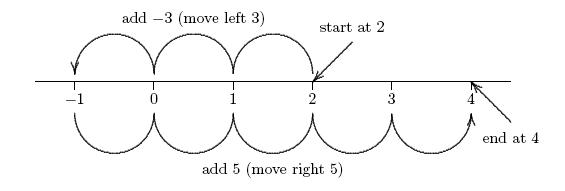
Now we're ready to combine the position and movement ideas in an addition problem. The process is illustrated first with an example:
Consider the problem:
$\,2 + (-3) + 5\,$
- The first number, $\,2\,,$ indicates a position. Go to $\,2\,$ on the number line.
- Adding a negative number indicates movement to the left. Thus, adding $\,-3\,$ says to move $\,3\,$ units to the left.
- Adding a positive number indicates movement to the right. Thus, adding $\,5\,$ says to move $\,5\,$ units to the right.
- You end up at position $\,4\,.$
Thus, $\,2 + (-3) + 5 = 4\,.$
The ‘Start at Zero’ Interpretation
Or, you can always start at zero! That is, write $2 + (-3) + 5$ as $0 + 2 + (-3) + 5$ . The first number indicates position, and the remaining numbers indicate movement. Start at $\,0\,,$ move $\,2\,$ to the right, $\,3\,$ to the left, and $\,5\,$ to the right, ending up at $\,4\,.$
You should understand both interpretations, but in practice you can use whichever is more natural to you. The start at zero interpretation is used in the following discussion.
You probably don't want to be drawing number lines every time you need to do an addition of signed numbers problem. The good news is that every problem—no matter how many numbers are involved—boils down to either a two-number addition problem, or a two-number subtraction problem, which can then be done efficiently in your head. Keep reading!
Adding Numbers with the Same Signs
When you add numbers with the same signs (both positive or both negative), then in your head you do an addition problem.
Here are two examples:
-
$2 + 3$
(Both numbers are positive.)
Start at zero. Move to the right $\,2\,,$ then to the right $\,3\,.$ End up at $\,5\,.$ Thus, $2 + 3 = 5\,.$ -
$(-2) + (-3)$
(Both numbers are negative.)
Start at zero. Move to the left $\,2\,,$ then to the left $\,3\,.$ The total distance moved is $\,2 + 3 = 5\,.$ You moved to the left, so you end up at $\,-5\,.$ Thus, $\, (-2) + (-3) = -5\,.$
Notice that in both of these problems, you do an addition problem in your head, which gives the total distance moved. If you always move to the right, then the final answer is positive. If you always move to the left, then the final answer is negative.
Adding Numbers with Different Signs
When you add numbers with different signs (one positive, one negative), then in your head you do a subtraction problem.
Here are two examples:
-
$2 + (-3)$
(first number is positive, second number is negative)
Start at zero. Move $\,2\,$ to the right and $\,3\,$ to the left. You moved more to the left—how much more?
Answer: $\,3 - 2 = 1$
So you end up at $\,-1\,.$ Thus, $\,2 + (-3) = -1\,.$ -
$3 + (-2)$
(first number is positive, second number is negative)
Start at zero. Move $\,3\,$ to the right and $\,2\,$ to the left. You moved more to the right—how much more?
Answer: $\,3 - 2 = 1\,.$
So you end up at $\,1\,.$
Thus, $\,3 + (-2) = 1\,.$
The mental process is this:
Once you recognize that you're adding numbers with different signs, throw away (for the moment) all the signs, take the bigger number, and subtract the smaller number. This gives you the net distance traveled.
If you moved farther to the right, then your answer is positive. If you moved farther to the left, then your answer is negative.
Notice that when you add numbers with different signs, then in your head you do a subtraction problem.
Five-Step Process for Adding Two Signed Numbers
When you add two signed numbers, you can follow this five step process. As you read through these steps, think of applying these questions to the problem $\,2 + (-3)\,$:
- Step 1: What numbers are being added? (Answer: $\,2\,$ and $\,-3\,$)
- Step 2: Do these numbers have the same sign or different signs? (Answer: different signs)
- Step 3: In your head, will you be doing an addition or subtraction problem? (Answer: subtraction problem)
- Step 4: Do the appropriate addition or subtraction problem. Answer: Throw away the signs, leaving you with $\,2\,$ and $\,3\,.$ Subtract the smaller from the larger: $\,3 - 2 = 1\,$
- Step 5: Is your answer positive or negative? Answer: The bigger number is negative, so the answer will be negative. So, $\,2 + (-3) = -1\,.$
More Than Two Numbers Being Added
If there are more than two numbers being added, just turn it into a two-number problem in the first step, by combining the positive and negative numbers separately, like this:
$ = (\,(-3) + (-2) + (-6)\,) \,+\, (5 + 1 + 4)$
(re-group, re-order, to combine negative and positive separately)
$ = -11 + 10$
$= -1$
Practice
Here, you will practice addition problems of the form ‘$\,x + y\,$’ where $\,x\,$ and $\,y\,$ can be any of these numbers: $\,-10, -9, -8, \ldots, -1, 0, 1, \ldots, 8, 9, 10\,.$ About half of the problems will involve variables!