 The Quadratic Formula
You may want to review preliminary information about quadratic functions and related concepts:
- Parabolas
- Equations of Simple Parabolas
- Quadratic Functions and the Completing the Square Technique
- Algebraic Definition of Absolute Value
- Solving More Complicated Equations Involving Perfect Squares
A quadratic equation is an equation of the form $\,ax^2 + bx + c = 0\,,$ where $\,a\ne 0\,.$
The quadratic formula solves quadratic equations. Just read off $\,a\,,$ $\,b\,,$ and $\,c\,,$ and substitute into the quadratic formula:
The Quadratic Formula: $$\cssId{s7}{x = \frac{-b\pm\sqrt{b^2-4ac}}{2a}}\ \ \text{(for $a\ne 0$)}$$
For example, solving the quadratic equation ‘$\,14x + 3x^2 = 5\,$’ is as simple as this:
$\color{blue}{b = 14}$
$\color{green}{c = -5}$
- $a\,$ (the coefficient of the $\,x^2\,$ term)
- $b\,$ (the coefficient of the $\,x\,$ term)
- $c\,$ (the constant term)
or
$\displaystyle \cssId{s32}{x} \cssId{s33}{= \frac{-14\,\color{red}{\large{\mathbf{-}}}\,16}{6}} \cssId{s34}{= \frac{-30}{6}} \cssId{s35}{= -5}$
Write the ‘$\,\color{orange}{\large{\mathbf{+}}}\,$’ and ‘$\,\color{red}{\large{\mathbf{-}}}\,$’ solutions separately.
Quadratic Functions and their Relationship to Quadratic Equations
Quadratic functions are functions that can be written in the form $\,ax^2 + bx + c\,$ for $\,a\ne 0\,.$ Every quadratic function graphs as a parabola with directrix parallel to the $x$-axis.
The graphs of quadratic functions can have three different $x$-intercept situations, as shown below:
- no $x$-intercepts
- exactly one $x$-intercept
- two different $x$-intercepts
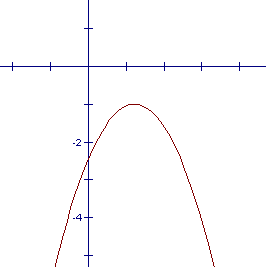 no $x$-intercepts
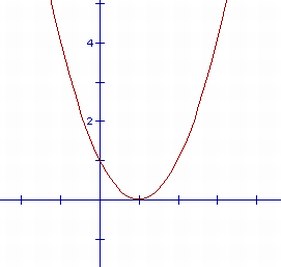 exactly one $x$-intercept
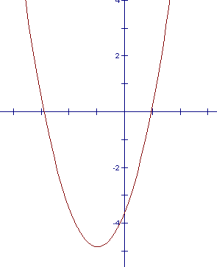 two different $x$-intercepts
Points on the $x$-axis have their $y$-value equal to zero. Thus, to find the $x$-intercepts for any curve, you set $\,y\,$ equal to zero and solve for $\,x\,.$
In particular, to find the $x$-intercepts of a quadratic function $\,y = ax^2 + bx + c\,$ ($\,a\ne 0\,$), it is necessary to solve the equation $\,ax^2 + bx + c = 0\,$ (which is called a quadratic equation).
The formula that gives the solutions to this equation is called the quadratic formula, and is derived next.
Derivation of the Quadratic Formula
Solving the Equation $\,ax^2 + bx + c = 0\,,$ where $\,a\ne 0\,$
Using the technique of completing the square, the equation is transformed to the form $\,z^2 = k\,,$ as follows:
$$z = \sqrt{k}\ \ \text{or}\ \ z = -\sqrt{k}$$
In both cases, the same two values for the right side result. Thus, we continue with a simplified right side:
In summary, we have:
Let $\,a\ne 0\,.$
The solutions to the equation $\,ax^2 + bx + c = 0\,$ are given by:
$$ \cssId{s117}{x = \frac{-b\pm\sqrt{b^2-4ac}}{2a}} $$The Discriminant of a Quadratic Equation or Quadratic Function
The expression $\,b^2 - 4ac\,$ that appears under the square root in the quadratic formula is critical in determining the nature of the solutions to the quadratic equation $\,ax^2 + bx + c = 0\,,$ as follows:
Positive Discriminant
If $\,b^2 - 4ac\gt 0\,,$ then $\sqrt{b^2-4ac}\,$ is a positive real number.
In this case, $$\cssId{s123}{\frac{-b \color{red}{+ \sqrt{b^2-4ac}}}{2a}}$$ and $$\cssId{s124}{\frac{-b \color{red}{- \sqrt{b^2-4ac}}}{2a}}$$ are different real numbers. Thus, there are two different real number solutions to the quadratic equation $\,ax^2 + bx + c = 0\,,$ and the graph of the quadratic function $\,ax^2+bx+c\,$ has two different $x$-intercepts.
Discriminant Equal to Zero
If $\,b^2 - 4ac= 0\,,$ then $\sqrt{b^2-4ac} = 0\,.$
In this case, $$\cssId{s131}{\frac{-b + \sqrt{b^2-4ac}}{2a} = \frac{-b\color{red}{+0}}{2a}}$$ and $$\cssId{s132}{\frac{-b - \sqrt{b^2-4ac}}{2a} = \frac{-b\color{red}{-0}}{2a}}$$ are the same numbers.
Thus, there is exactly one real number solution to the quadratic equation $\,ax^2 + bx + c = 0\,,$ and the graph of the quadratic function $\,ax^2 + bx + c\,$ has only one $x$-intercept.
Negative Discriminant
If $\,b^2 - 4ac\lt 0\,,$ then $\,\sqrt{b^2-4ac}\,$ is not a real number.
In this case, there are no real number solutions to the quadratic equation $\,ax^2 + bx + c = 0\,,$ and the graph of the quadratic function $\,ax^2+bx+c\,$ has no $x$-intercepts.
The Discriminant Discriminates...
Thus, the expression $\,b^2 - 4ac\,$ helps us to discriminate between the various types of solutions to a quadratic equation, and the various $x$-intercept situations for a quadratic function.
Thus, we have the following definition:
Let $\,a\ne 0\,.$
The expression $\,b^2 - 4ac\,$ is called the discriminant of the quadratic equation $\,ax^2 + bx + c = 0\,.$
Similarly, the expression $\,b^2 - 4ac\,$ is called the discriminant of the quadratic function $\,ax^2 + bx + c\,.$