 Equations of Simple Parabolas (Part 1)
(This page is Part 1. Click here for Part 2.)
You may want to review the prior web exercise, Parabolas.
If a parabola is placed in a coordinate plane in a simple way, then a simple equation is obtained.
- Derivation: parabola with vertex at origin, focus on $y$-axis
- Equations of simple parabolas
- Memory Device: ‘one over four pee pairs’
- Shifting the parabola
- Graphing a shifted parabola
Derivation
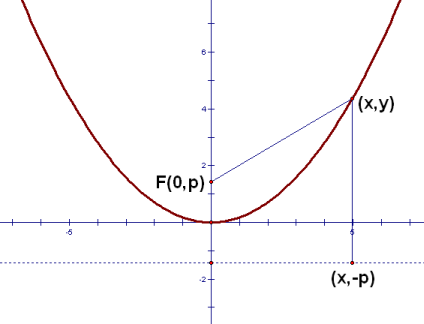
Place a parabola with its vertex at the origin, as shown below.
-
If we put the focus on the $y$-axis, then the directrix will be parallel to the $x$-axis.
-
Or, if we put the directrix parallel to the $x$-axis, then the focus will be on the $y$-axis.
In either case, let $\,p \ne 0\,$ denote the $y$-value of the focus. Thus, the focus has coordinates $\,(0,p)\,.$
Although the sketch above shows the situation where $\,p\gt 0\,,$ the following derivation also holds for $\,p \lt 0\,.$
Notice that:
| $p\gt 0$ | if and only if | the focus is above the vertex | if and only if | the parabola is concave up (holds water) |
| AND | ||||
| $p\lt 0$ | if and only if | the focus is below the vertex | if and only if | the parabola is concave down (sheds water) |
For example, if the focus is above the vertex, then $\,p\,$ must be greater than zero, and the parabola must be concave up. As a second example, if the parabola is concave down, then $\,p\,$ must be less than zero, and the focus is below the vertex.
Since the vertex is a point on the parabola, the definition of parabola dictates that it must be the same distance from the focus and the directrix.
Thus, the directrix must cross the $y$-axis at $\,-p\,$; indeed, every $y$-value on the directrix equals $\,-p\,.$
Let $\,(x,y)\,$ denote a typical point on the parabola.
The distance from $\,(x,y)\,$ to the focus $\,(0,p)\,$ is found using the distance formula: $$ \tag{1} \cssId{s36}{\sqrt{(x-0)^2 + (y-p)^2 } = \sqrt{x^2 + (y-p)^2}} $$
To find the distance from $\,(x,y)\,$ to the directrix, first drop a perpendicular from $\,(x,y)\,$ to the directrix. This perpendicular intersects the directrix at $\,(x,-p)\,.$ The distance from $\,(x,y)\,$ to the directrix is therefore the distance from $\,(x,y)\,$ to $\,(x,-p)\,$:
$$ \tag{2} \cssId{s40}{\sqrt{(x-x)^2 + ((y-(-p))^2} = \sqrt{(y+p)^2}} $$From the definition of parabola, distances $\,(1)\,$ and $\,(2)\,$ must be equal:
$$ \cssId{s42}{\sqrt{x^2 + (y-p)^2} = \sqrt{(y+p)^2}} $$This equation simplifies considerably, as follows:
| Squaring both sides: | $ x^2 + (y-p)^2 = (y+p)^2 $ |
| Multiplying out: | $ x^2 + y^2 - 2py + p^2 = y^2 + 2py + p^2 $ |
| Subtracting $\,y^2 + p^2\,$ from both sides: | $ x^2 - 2py = 2py $ |
| Adding $\,2py\,$ to both sides: | $ x^2 = 4py $ |
| Dividing by $\,4p\,$ and rearranging: | $ \displaystyle y = \frac{1}{4p} x^2 $ |
Such a beautiful, simple description for our parabola! The most critical thing to notice is the coefficient of $\,x^2\,,$ since it holds the key to locating the focus of the parabola.
As an example, consider the equation $\,y = 5x^2\,.$ Comparing $\,y = 5x^2\,$ with $\,y = \frac1{4p}x^2\,,$ we see that $\, 5 = \frac{1}{4p}\,.$ Solving for $\,p\,$ gives:
| $\displaystyle 5 = \frac{1}{4p}$ | original equation |
| $20p = 1$ | multiply both sides by $\,4p$ |
| $\displaystyle p = \frac{1}{20}$ | divide both sides by $\,20$ |
Thus, $\,y = 5x^2\,$ graphs as a parabola with vertex at the origin, and focus $\,(0,\frac{1}{20})\,.$ So easy!
In summary, we have:
Every equation of the form $\,y= ax^2\,$ (for $\,a\ne0\,$) is a parabola with vertex at the origin, directrix parallel to the $x$-axis, and focus on the $y$-axis.
If $\,a\gt 0\,,$ then the parabola is concave up (holds water).
If $\,a\lt 0\,,$ then the parabola is concave down (sheds water).
If $\,p\,$ denotes the $y$-value of the focus, then $\,a = \frac{1}{4p}\,.$ Solving for $\,p\,$ gives $\, p = \frac{1}{4a}\,,$ and thus the coordinates of the focus are $\,(0,\frac{1}{4a})\,.$
Memory Device: ‘one over four pee pairs’
Notice that if $\,a = \frac{1}{4p}\,,$ then $\,p = \frac{1}{4a}\,.$ Or, if $\,p = \frac{1}{4a}\,,$ then $\,a = \frac{1}{4p}\,.$ What a beautiful symmetric relationship!
Thus, I fondly refer to $\,a\,$ and $\,p\,$ with the catchy phrase: ‘one over four pee pairs’. (Try to say this quickly ten times in a row!)
If you know either $\,a\,$ or $\,p\,,$ then it's easy to find the other—just multiply by $\,4\,$ and then flip (take the reciprocal).
For example, if you know that $\,a = 5\,,$ then $\,p\,$ is found as follows:
-
$4\times 5 = 20\,$ (multiply by $\,4\,$)
-
$p=\frac{1}{20}$ (flip)
Or, if you know that $\,p = \frac{1}{20}\,,$ then $\,a\,$ is found as follows:
-
$4\times \frac{1}{20} = \frac{4}{20} = \frac{1}{5}\,$ (multiply by $\,4\,$)
-
$a = (\text{the reciprocal of } \frac{1}{5}) = 5\,$ (flip)