 Introduction to Systems of Equations
You may want to review:
First, we firm up some terminology that is important when talking about systems of equations. (Or, skip this review and jump right to the information on systems.)
For example, ‘$\,4x^3 - x + 3 = 5x - 7\,$’ is an equation in one variable.
For example, ‘$\,2x^2 - xy + 3y^2 = 5x - 7y + 1\,$’ is an equation in two variables.
The phrase ‘in $\,n\,$ variables’ also applies to inequalities: for example, ‘$\,x^2 - 3x \gt 4 + x\,$’ is an inequality in one variable.
Parameters versus Variables
The equation ‘$\,ax + by + c = 0\,$’ can be a bit confusing. At first glance, it looks like there might be five variables, not two: $\,a\,,$ $\,b\,,$ $\,c\,,$ $\,x\,,$ and $\,y\,.$
The letters $\,a\,,$ $\,b\,$ and $\,c\,,$ however, serve a very different purpose in this equation. They are called parameters—they are constant for any particular equation, but are allowed to vary from equation to equation.
By using parameters, the single equation ‘$\,ax + by + c = 0\,$’ very compactly describes an entire family of equations, including, say:
$$ \begin{align} &\cssId{s47}{2x + 3y + 4 = 0}\cr &\qquad \cssId{s48}{(a = 2,\ b = 3,\ c = 4)}\cr\cr &\cssId{s49}{x - y = 0}\cr &\qquad \cssId{s50}{(a = 1,\ b = -1,\ c = 0)}\cr\cr &\cssId{s51}{\frac13y -\pi = 0}\cr &\qquad \cssId{s52}{(a = 0,\ b = \frac13,\ c = -\pi)} \end{align} $$Behold the power of the mathematical language—that a single equation can so simply and concisely describe an infinite number of equations! The constants $\,a\,,$ $\,b\,$ and $\,c\,$ can be any real numbers, as long as $\,a\,$ and $\,b\,$ aren't zero at the same time.
Key Idea of Linearity
Here's the key idea of linearity—in a linear equation, the variables must appear as simply as possible. The variables must appear only to the first power. No variables in denominators. No variables inside square roots, and so on.
Here are more examples of linear equations in two variables. Notice that by using the addition property of equality, each of these equations can be put in the form $\,ax + by + c = 0\,$:
$$ \begin{gather} \cssId{s66}{y=3x-5}\cr \cssId{s67}{x+2y-3=0}\cr \cssId{s68}{\frac{2x}{3} - \frac{1}{7}y =\sqrt{5}\,x + 6} \end{gather} $$Horizontal and Vertical Lines (either $\,a\,$ is zero, or $\,b\,$ is zero, but not both)
Recall that every linear equation in two variables graphs as a line.
Notice that in a linear equation $\,ax+by+c=0\,,$ $\,a\,$ and $\,b\,$ cannot both be zero, but exactly one of them can be zero. Thus, in the proper context, both $\,x=3\,$ and $\,y=3\,$ can be viewed as equations in two variables, even though you only see one variable!
When viewed as an equation in two variables, the equation $\,x=3\,$ is really the equation $\,x+0y=3\,.$ Its graph is the set of all points of the form $\,(3,y)\,,$ where $\,y\,$ can be any real number. This is a vertical line.
Similarly, when viewed as an equation in two variables, the equation $\,y=3\,$ is really the equation $\,0x+y=3\,.$ Its graph is the set of all points of the form $\,(x,3)\,,$ where $\,x\,$ can be any real number. This is a horizontal line.
So, how are you to know when $\,x=3\,$ is being viewed as an equation in one variable (where the only solution is the number $\,3\,$), or as an equation in two variables (where there is a whole line of solutions)?
Context!
If someone says ‘graph $\,x=3\,$’ then they're usually viewing it an an equation in two variables. When $\,x=3\,$ is viewed as an equation in one variable, then its ‘graph’ is just one dot (at $\,3\,$) on a number line, which is pretty boring!
Need practice working with lines? Study sections 45 and 46 in the online Algebra I curriculum One Mathematical Cat, Please! A First Course in Algebra.
In general, the word system (in mathematics) refers to more than one. For example, here is a system of two linear equations in two unknowns:
$$ \begin{gather} \cssId{s103}{y=x+1}\cr \cssId{s104}{3x+y = 5} \end{gather} $$In a system, the sentences are assumed to be connected with the mathematical word and, even though this word does not explicitly appear.
For example, the system above is really a shorthand for:
$$\cssId{s108}{(y=x+1)\ \ \text{ and }\ \ (3x+y=5)}$$For example, $\,x=1\,$ and $\,y=2\,$ is a solution of the system $$ \begin{gather} \cssId{s114}{y=x+1}\cr \cssId{s115}{3x+y = 5} \end{gather} $$ since substitution of $\,1\,$ for $\,x\,$ and $\,2\,$ for $\,y\,$ makes both equations true:
$$ \begin{gather} \cssId{s117}{2 = 1 + 1}\cr \cssId{s118}{3\cdot 1 + 2 = 5} \end{gather} $$That is, the point $\,(x,y) = (1,2)\,$ lies on the line $\,y=x+1\,$ and also lies on the line $\,3x+y=5\,.$
Notice that a single solution corresponds to a choice of two numbers. It is convenient to say:
the ordered pair $\,(1,2)\,$ is a solution of the system
Notice that the first coordinate is the $\,x$-value, and the second coordinate is the $\,y$-value. This particular system has only one solution—the ordered pair $\,(1,2)\,.$
How Many Solutions Can a System of Two Linear Equations in Two Unknowns Have?
The answer is simple, since two lines in a plane can only interact in three possible ways:
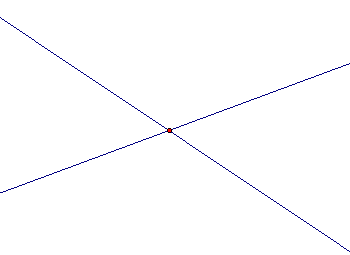
If the two lines intersect in a single point, then the system has exactly one solution. This is the most common situation.
If the two lines are parallel, then there are no points that lie on both lines. In this case, the system has no solutions.

If the two lines are the same, then there are infinitely many solutions—every point on the line is a solution!

Thus, a system of two linear equations in two unknowns has:
- exactly one solution;
- no solutions; or
- infinitely many solutions (a whole line's worth of solutions).
You'll learn two methods for solving systems in the next two web exercises: the substitution method and the elimination method.