 Introduction to Exponential Functions (Part 1)
(This page is Part 1. Click here for Part 2.)
You may also want to review basic properties of logarithmic functions: Introduction to Logarithmic Functions
Most of your experience thus far has likely been with functions where the base is a variable, and the exponent is a constant, like these:
- $\,y=x=x^1\,$ (the identity function)
- $\,y=x^2\,$ (the squaring function)
- $\,y=x^3\,$ (the cubing function)
- $\,y=\sqrt{x}=x^{1/2}\,$ (the square root function)
- $\,y=\frac{1}{x}=x^{-1}\,$ (the reciprocal function)
Functions with a variable base and a constant exponent are called power functions.
Switch the role of variable and constant and you get an entirely new family of functions, called exponential functions, which are the subject of this section. For example, these are all exponential functions:
- $y=2^x$
- $y={(\frac{1}{2})}^x$
- $\,y={\text{e}}^x$
The precise definition follows:
An exponential function is a function of the form $\,y=b^x\,,$ where $\,b\,$ is a positive number not equal to $\,1\,,$ and $\,x\,$ is any real number.
Thus, exponential functions have a constant base; the variable is in the exponent.
The number $\,b\,$ is called the base of the exponential function.
The most important exponential function is when the base is the irrational number $\,\text{e}\,.$ (Note: $\text{e}\approx 2.71828\,$) In this case, the function is also written as $\ \exp(x)\,,$ and is called the natural exponential function.
If you hear the phrase ‘the exponential function’ (meaning only one) then the function being referred to is $\,y={\text{e}}^x=\exp(x)\,.$
Some mathematicians (this author included) tend to call more general functions with a constant base and variable in the exponent exponential functions; say, $\ y={\text{e}}^{2x-3}\ $ or $\ y=-7\cdot 3^{5-x}\,.$ However, for the purposes of this section, the phrase exponential function refers only to functions of the form $\,y=b^x\,.$
Why must the base of an exponential function be positive? For negative numbers, there are problems for many values of $\,x\,$: for example, $\,(-4)^{1/2} = \sqrt{-4}\,$ is not a real number.
Why can't the base be $\,1\,$ or $\,0\,$? The base can't be $\,1\,,$ because $\,1^x \ \overset{\text{always}}{=}\ 1\,,$ so the function $\,1^x\,$ is a constant function. There is a similar problem with zero as the base.
There are two basic shapes to the graphs of exponential functions, depending on whether the base is greater than $\,1\,,$ or between $\,0\,$ and $\,1\,$:
$\,y=b^x\,$ for $\,b\gt 1\,$
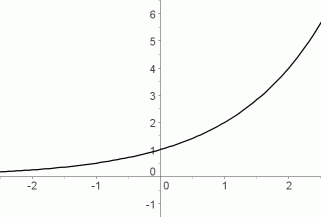
increasing functions;
also called growth functions
$\,y=b^x\,$ for $\,0\lt b\lt 1\,$
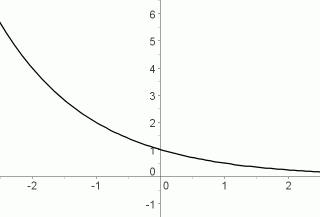
decreasing functions;
also called decay functions
Properties of the Graph for $\,b\gt 1\,$
An increasing function has the following property: as you walk along the graph, going from left to right, you are always going uphill.
The following are equivalent for a function $\,f(x)=b^x\,$:
- $f\,$ is an increasing function
- $b\gt 1\,$
For increasing exponential functions:
-
as $\,x\rightarrow \infty \,,$
$\,y\rightarrow \infty \,$
Read this aloud as: as $\,x\,$ goes to infinity, $\,y\,$ goes to infinity -
as $\,x\rightarrow -\infty \,,$
$\,y\rightarrow 0\,$
Read this aloud as: as $\,x\,$ goes to negative infinity, $\,y\,$ approaches zero
It is important to note that increasing exponential functions increase VERY quickly.
For example, suppose you are walking along the graph of $\,y={\text{e}}^x\,,$ moving from left to right. By the time $\,x\,$ is $\,7\,,$ the outputs are already greater than $\,1000\,.$
Even more impressive is this fact: as you pass through the point that has $y$-value $\,1000\,,$ the slope of the tangent line is also $\,1000\,,$ so the outputs are changing $\,1000\,$ times faster than the inputs at this point! It would feel like you are climbing a vertical cliff (see below)! (Now, repeat this paragraph with the number $\,1000\,$ replaced by any large number of your choosing!)
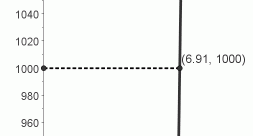
increasing functions
as $\,x\rightarrow \infty \,,$ $\,y\rightarrow \infty \,$
as $\,x\rightarrow -\infty \,,$ $\,y\rightarrow 0\,$
Properties of the Graph for $\,0\lt b\lt 1\,$
A decreasing function has the following property: as you walk along the graph, going from left to right, you are always going downhill.
The following are equivalent for a function $\,f(x)=b^x\,$:
- $\,f\,$ is a decreasing function
- $\,b\,$ is between $\,0\,$ and $\,1\,$
For decreasing exponential functions:
-
as $\,x\rightarrow \infty \,,$
$\,y\rightarrow 0\,$
Read this aloud as: as $\,x\,$ goes to infinity, $\,y\,$ approaches zero -
as $\,x\rightarrow -\infty \,,$
$\,y\rightarrow \infty \,$
Read this aloud as: as $\,x\,$ goes to negative infinity, $\,y\,$ goes to infinity
decreasing functions
as $\,x\rightarrow \infty \,,$ $\,y\rightarrow 0 \,$
as $\,x\rightarrow -\infty \,,$ $\,y\rightarrow \infty\,$