 Basic Arithmetic With Matrices
You may want to review: Introduction to Matrices
Whenever you get a new mathematical object (like matrices), it's important to develop tools to work with the new object.
In this exercise, you'll learn how to do basic arithmetic operations with matrices: adding, subtracting, and multiplying by a constant.
Adding and Subtracting Matrices
Matrices can only be added or subtracted when they have the same size. In this situation, you just add/subtract the corresponding entries.
For example:
$$ \begin{align} &\cssId{s11}{\begin{bmatrix} -2 & 1\cr 0 & 3 \end{bmatrix}} \cssId{s12}{+} \cssId{s13}{\begin{bmatrix} 5 & -4\cr 6 & -7 \end{bmatrix}}\cr\cr &\qquad \cssId{s14}{=} \cssId{s15}{\begin{bmatrix} -2+5 & 1+(-4)\cr 0+6 & 3+(-7) \end{bmatrix}}\cr\cr &\qquad \cssId{s16}{=} \cssId{s17}{\begin{bmatrix} 3 & -3\cr 6 & -4 \end{bmatrix}} \end{align} $$$$ \begin{align} &\cssId{s18}{\begin{bmatrix} -2 & 1\cr 0 & 3 \end{bmatrix}} \cssId{s19}{-} \cssId{s20}{\begin{bmatrix} 5 & -4\cr 6 & -7 \end{bmatrix}}\cr\cr &\qquad \cssId{s21}{=} \cssId{s22}{\begin{bmatrix} -2-5 & 1-(-4)\cr 0-6 & 3-(-7) \end{bmatrix}}\cr\cr &\qquad \cssId{s23}{=} \cssId{s24}{\begin{bmatrix} -7 & 5\cr -6 & 10 \end{bmatrix}} \end{align} $$
Precisely, we have:
Suppose matrices $\,A\,$ and $\,B\,$ have the same size.
Then, the sum $\,S=A+B\,$ is defined by: $$ \cssId{s30}{s_{ij} = a_{ij} + b_{ij}} $$
The difference $\,D=A-B\,$ is defined by: $$ \cssId{s32}{d_{ij} = a_{ij} - b_{ij}} $$
In particular, matrices with different sizes cannot be added or subtracted.
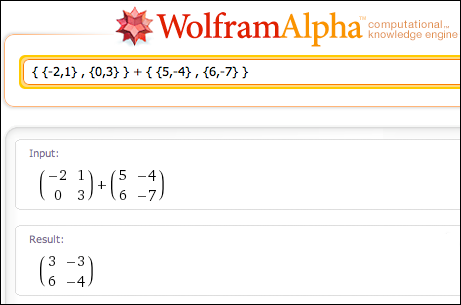
WolframAlpha uses braces $\,\{\ \}\,$ to input matrices, not brackets $\,[\ ]\,.$ Then, it displays the matrices (so you can verify your input) using parentheses $\,(\ )\,.$ Get used to this—different academic disciplines and different environments often use different notation.
The screenshot below shows how to input matrices at wolframalpha.com.
Each row goes inside a pair of braces $\,\{\ \}\,,$ with elements separated by commas, like this: $$\cssId{s45}{\{-2,1\}}$$
The rows themselves are also separated by commas, like this: $$\cssId{s47}{\{-2,1\}}\ \cssId{s48}{\ ,\ } \cssId{s49}{\{0,3\}}$$
The entire matrix is enclosed within a pair of braces, like this: $$\cssId{s51}{\{}\ \cssId{s52}{\{-2,1\}}\cssId{s53}{\ ,\ }\cssId{s54}{\{0,3\}}\ \cssId{s55}{\}}$$
If you want, cut-and-paste the following input to WolframAlpha to duplicate what you see in the image below:
{ {-2,1} , {0,3} } + { {5,-4} , {6,-7} }
Multiplying a Matrix by a Constant
It is equally easy to multiply a matrix by a constant; each entry gets multiplied by the constant.
For example,
$$ \begin{align} &\cssId{s62}{7} \cssId{s63}{\begin{bmatrix} -2 & 1\cr 0 & 3 \end{bmatrix}}\cr\cr &\qquad \cssId{s64}{=} \cssId{s65}{\begin{bmatrix} 7(-2) & 7(1)\cr 7(0) & 7(3) \end{bmatrix}}\cr\cr &\qquad \cssId{s66}{=} \cssId{s67}{\begin{bmatrix} -14 & 7\cr 0 & 21 \end{bmatrix}} \end{align} $$Precisely, we have:
Let $\,M\,$ be a matrix, with members $\,m_{ij}\,.$ Let $\,k\,$ be a real number.
Then, the new matrix $\,kM\,$ has the same size as $\,M\,$; the member in row $\,i\,$ and column $\,j\,$ of $\ kM\ $ is $\ k\,m_{ij}\ .$
Note: The real number multiplier is often called a constant or a scalar.
When working with matrices, it's important to distinguish between the real number $\,0\,$ and a zero matrix. To help with this distinction, we define $\,0_{m\times n}\,$ (zero, with a subscript of $\,m\times n\,$) to mean the zero matrix of size $\,m\times n\,.$
You can read $\,0_{m\times n}\,$ aloud as ‘the $\,m\,$ by $\,n\,$ zero matrix’.
Thus, if $\,A\,$ is a $\,2\times 3\,$ matrix, then: $$ \cssId{s90}{A-A} \cssId{s91}{=} \cssId{s92}{0_{2\times 3}} $$
Or, if $\,A\,$ is a $\,p\times q\,$ matrix, then: $$ \cssId{s94}{0A} \cssId{s95}{=} \cssId{s96}{0_{p\times q}} $$
Be aware that many advanced textbooks write simple things like $\,A-A=0,\,$ knowing that the audience has enough mathematical maturity to realize that the zero is really the zero matrix with the same size as $\,A\,.$ However, in this exercise, we will be careful to distinguish between the real number zero, and a zero matrix.
Examples
Let $ A = \left[ \begin{smallmatrix} 2 & -1\cr 0 & 3\end{smallmatrix} \right] \,,$ $ B = \left[ \begin{smallmatrix} -3 & -5\cr 1 & 0\end{smallmatrix} \right] \,,$ and $ C = \left[ \begin{smallmatrix} 0 & 1 & 1\cr 2 & -1 & 0\end{smallmatrix} \right] \,.$
Then:
$$ \begin{align} &\cssId{s109}{A+2B}\cr\cr &\qquad \cssId{s110}{=} \cssId{s111}{\begin{bmatrix} 2 & -1\cr 0 & 3 \end{bmatrix}} \cssId{s112}{+} \cssId{s113}{2} \cssId{s114}{\begin{bmatrix} -3 & -5\cr 1 & 0 \end{bmatrix}} \cr\cr &\qquad \cssId{s115}{=} \cssId{s116}{\begin{bmatrix} 2 & -1\cr 0 & 3 \end{bmatrix}} \cssId{s117}{+} \cssId{s118}{\begin{bmatrix} -6 & -10\cr 2 & 0 \end{bmatrix}} \cr\cr &\qquad \cssId{s119}{=} \cssId{s120}{\begin{bmatrix} -4 & -11\cr 2 & 3 \end{bmatrix}} \end{align} $$As a second example, $\,A+C\,$ is not defined, since $\,A\,$ and $\,C\,$ have different sizes.